Monday, May 24, 2010

It’s not always the action that’s important


Former Port Orchard Independent reporter, Mark Walker, once told me after looking at a few of my sports action features, “Get the ball in the frame and in focus!”  Well, that’s silly coming from a wordsmith and not a photographer. I tried explaining to him that I was trying to capture the after action reaction of a game saving play, which to me is as important as actual action shot. However, it did piss me off so much that from then on I made it a point to capture both, action and reaction of every play.

But To me, sometimes, the after reaction of a significant play is almost just as important or sometimes more important than the play itself.  However, in this digital age, it’s good to capture both. It’s all about seeing pictures possibilities and capturing those moments that lead to great photographic moments.

Here's a picture I captured the other night of Ken Griffey, Jr., being congratulated after hitting the game winning single against the Toronto Bluejays. I managed to capture a story telling photo of Bluejays' first baseman Lyle Overbay (R) walking off the field as Seattle Mariners' Ken Griffey Jr. (L) is surrounded by teammates after he hit a single to right field that scored the game winning run in the ninth inning. Griffey pinch-hitting for Josh Wilson hit a game winning single to right field that scored Milton Bradley to beat the Bluejays 4-3.  I like the fact that I was able to capture the both the happiness and dejection in the same frame. The happiness of the Mariners players and the dejection displayed by Overbay as he walked off the field with his head down definitely told the story better than Griffey swatting the ball.

Other pictures that display reactions are:  Manchester United's Roy Keane, middle, congratulates Ole Gunnar Solskjaer, left, after he scored the third goal of the first half against the Celtic goalie Magnus Hedman.

Alabama's Blair Potter, left, and Jessica Smith watch the Washington team celebrate their 7-5 win in the NCAA Softball Super Regional game Saturday May 26, 2007 in Seattle.  Washington beat Alabama 7-5 to advance to the College World Series.

Seattle Seahawks defensive end Patrick Kerney celebrates his sack of Tampa Bay Buccaneers quarterback Jeff Garcia in the second quarter of their season opener at Qwest Field in Seattle.


And lastly, the look on the base runner’s face as he’s called out during a Babe Ruth baseball game. If he had scored, the game would have gone into extra innings.

As you can see in the posted photos……..sometimes that reaction tells the story better than the action.

Friday, May 21, 2010

Using angles and lenses in visual story-telling


At a recent photo lecture I gave on travel photography, an attendee asked, “I’ve been to some of the same places as you, own similar equipment too, but my photos aren’t as good as yours . Why?”

The only difference I’ve come across elevating the professionals from amateurs is that the professionals think before and while they photograph. I’m always on the lookout, taking mental notes of a scene, taking time to find high or low angles in which to shoot from and always looking for that perfect “magic” light to shoot in, even if I have to return later to capture it.

Sooner or later you’ll be asked to share your pictures, in either a to your friends or associates in the form of a slide show, power point presentation of a display prints.

While you can build these projects around a central theme or subject, try to show an overall feeling of the “spirit” of the place you photographed, rather than just a single theme, for a more visual story.

There is a logic structure in visual storytelling, and you see those technique used everyday on television and in the movies. They are both visual storytelling mediums, and directors use the same techniques to pull you into the story. The same is used in telling stories with photos.

As a still photographer, we can learn a lot from these visual story-telling techniques. The cameraman and director of photography use different types of shots and angles ranging from overalls to close-ups, to establish a story line. The next time you watch a movie, turn off the sound and study the mixture of shots that are used. These same types of shots are useful to keep in mind when you go cover a place with your camera.

Establishing shot – Wide-angle overview that sets up the scene. This is often a high angle shot that will give the viewer a really good idea of the setting.

Medium shot - Usually a closer up view than the establishing shot. Street scenes can be taken with any lens ranging from a wide angle, standard to slight telephoto lenses. I like using my 16-35mm and 70-200mm to capture these types of images.

Close-up shot – Are often pictures that show storytelling details, such as faces, hands, signage, architectural details, food, drink, and artwork.

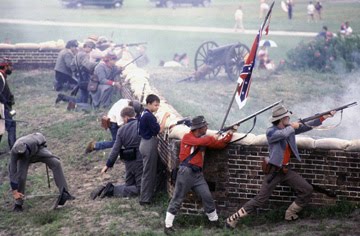
Point of view shot – Are shots taken from the angle of a participant in an event or action, such as soldier’s view of the battlefield. The POV shots are more of a moving-picture technique than a still-photo, but you can make exciting POV shots by using unusual viewpoints like very high or low angles.

Look for different angles to photograph from. There’s no rule that says everything must be shot from the eye level, so shoot the same subject from low to high angles, even at ground level sitting on your butt, kneeling or laying on your stomach. Each angle will give you a different prospective of the scene.

Every time you set out to photograph a situation, be it a street fair, a market or a walk about through the countryside, keep in mind this mix of shots. Each is important, if you take all establishing shots or all close-ups, you’ll loose the attention of your viewers. In everything you cover, get the establishing shots, the medium shots, detail and close-ups, and if possible the POV shot.

One thing I’ve learned from years of picture taking is “Dare to be different!” All rules of photographic composition can be broken. Break all the rules, be creative, shoot your pictures from the heart and you’ll stand out from the rest.

Thursday, May 20, 2010

Seeing in details


Over the years, photojournalists reach a point where they refine their personal approach to shooting skills. Each approach is different, but most of whom I have talked too all agrees that the basis of such a visual approach is the trained ability to see everything in great detail.

The late Frank Hoy, who I had as an instructor at the Newhouse School of Public Communications at Syracuse University and who later taught at Arizona State University, taught his students an exercise in detailed seeing called the EDFAT – Entire, Details, Frame, Angles, and Time, a method that allows you to fine-tune your photographic seeing.

This approach works as well with things as well as people. EDFAT will help you explore the familiar as if it was a brand new subject.

For a start, organize your seeing in terms of using three categories: the establishing shot, the medium shot, and the close up. Apply this approach to everything you see.

The old saying, “what you see you can photograph” only applies to someone who sees in detail. So take the time to make a short field trip as a practical test method. Sling your camera on your shoulder and carry it with you while you learn to see deeply and in detail during a short walking tour in an area where there are a lot of people.

As a photojournalist you will constantly deal with strangers, so your subject should be someone unknown. Approach the subject and introduce yourself. Explain what you want: A complete portrait of them based on shooting many photographs. You’ll be surprised on just how cooperative most people are when you explain your needs. When the subject agrees to be photograph, move back to about 15 feet and start shooting.

ENTIRE: From 15 feet away, focus on the entire person as part of the environment and shoot one or two horizontal shots. Turn the camera to a vertical position and shoot two more. Move around the person and compose each shot differently in some strong composition. Don’t place the person in the center of the frame. While shooting, explore the person through your lens. Move in and from about 10 feet away, repeat the procedure. Then move in to about 7 feet and repeat your shooting process.

DETAILS: Now from 5 feet away search for details of the person now you are long longer photographing a person in relation to a large background, but you are making a portrait. So concentrate from the waist up. Shoot two horizontal frames and then to vertical frames. In doing this, you are framing the person in relation to the edge of your photograph and are now exploring the composition possibilities that come to mind. Use feet, books, boots, a hat, hair, eyes, and even the background elements to compose a variety of photographs: no two shots should be the same. Talk with the person as you shoot. Get to know the person’s background and personality. Soon they won’t be a subject anymore, but an interesting individual.

ANGLES: What would this person look like from a different angle? If you had taken all your shots so far from eye level and straight ahead, now take shots from the left and then right, from both high and low angles. Look for something to stand on, or even sit on your butt to get an especially low angle.

Now move in really close, to the shortest focal distance your lens with focus. Study the details on the subjects face. Concentrate on photographing a shot with just the eyes, nose, lips and hair and features of the face. At this close distance they are your material for a close-up. Remember to shoot both horizontal and vertical shots. Try to get your subjects hands in the photo, perhaps close to the face to frame it. By now you are working with you’re subject to get a character study, or what is called a personality portrait.

TIME: During this shooting exercise, you have been using the fifth element of EDFAT – time – in two ways: first as a series of shutter speeds to capture the action and second, as a span of time that allows you to explore in full details many visual possibilities of a single subject.

More importantly, you have introduced yourself to a way to be photographically perceptive.


Wednesday, May 19, 2010

Gotta have that gift of the gab

I love taking personality portraits that go beyond photographing a face that shows some interesting aspect of the subject’s character or personality.

My wife, Amy, has mentioned throughout the years that I can be embarrassing when out in public taking pictures. “How can you walk up to a perfect stranger, talk to them like you’ve known them for years and then get a picture?”

I don’t know, maybe I’m one of those photographers who have a special knack for setting my subjects at ease and a gift of the gab. But, mostly, it takes, experience, being very perceptive and extremely stubborn. When I want to make a picture of an interesting person, I don’t care how long it might take. Once, while trying to take a portrait of a carnival worker, he asked why I wanted to take a picture of him? “You have an interesting face”, I replied. Still, he refused, so I hung around talking, asking him about the life of a carnie, some of the towns he’s visited and how long he’s been a ride operator. Soon, kids started lining up to ride, as he started taking tickets, he asked, “You’re not gonna leave here until you take my picture are you? I smiled, and said, “I’ve got all day” and like I said, “you have an interesting face.”

“What the hell, take my picture!”, he snapped back, stuck the cigar in his mouth and glared at me.

My favorite technique is moving in with my 70-200mm lens for a close-up to ensure a strong center of interest and simple composition. One of the things I try to do is capture the subject’s character and emotional appeal.

In order to produce a good personality portrait, especially when dealing with those subjects who don’t want their pictures taken, a photographer must be part psychologist and part interviewer. To me, this shows the subject that you are interested in them, not as just a subject, but a human. Sooner or later, if they are busy, they’ll give in and allow a photo to be made. Besides, having that gift of the gab, doesn’t hurt at all either. Being a photojournalist, it’s our job to return with a
grabber shot…the one that tells the story or captures the character of someone.

Tuesday, May 18, 2010

Go out and shoot pretty pictures

While working at the Florida Times-Union, a former picture editor, Charles Kogod, offered me a bit of advice one slow news day. “Jim, just go out and shoot some pretty pictures!” Being a news photographer, I didn’t think that pretty pictorial or scenic could also go into the paper as a weather feature. Kogod knew what he was doing nurturing and developing photographers as he ended up working for National Geographic’s Special as the Director of Illustrations in the publications division for many years. Now, he photographs, teaches and edits. http://www.charleskogod.com/

Sitting on the back deck, reading a book, I noticed a huge, white billowing cloud formation rising up from the easterly direction. Gabbing my cameras, our dog, Toshio, started to jump and dance around me as he’s always up for a good walk, We jumped in to the car and headed off to Manchester Dock to take pictures of the magnificent cloud over Seattle.

To this very day, almost 30 years later, I still take Charles’ advice to heart and go out to shoot pretty pictures. One this day, my instincts paid off and I was rewarded with an unusual weather feature.

Monday, May 17, 2010

My camera goes with me everywhere


I once had a friend, who commented to me about always carrying my camera around everywhere I went like Charlie Brown's blanket-toting best friend Linus van Pelt.  It’s true I don’t want to put myself in the situation of missing a picture. It’s a way of life for most photojournalists, besides most people around town wouldn’t recognize me without a camera hanging from my neck. And I certainly don’t want to miss capturing an image such as the one posted above.

Even after a hard days work, whether I’ve been cruising for a feature picture or after covering two to four assignments, my cameras are always by my side.

Feature photos are a favorite of photojournalist because they are human interest in a creative way that shows readers a “slice of life” and a view of daily life.

Most days after dinner, I would pile those that wanted to go, into the car and we’d head off to discover South Kitsap County to play at one of it lakes or parks.  Since Long Lake Park was nearby and always offered some good feature photography that was our favorite location.

On this particular evening, while the kids were playing in the water and I was on the lookout for an interesting situation to photograph, out of the corner of my eye, I noticed a blur of activity.  Here was this young man, headed to the water with his Golden Retriever, Diesel, in hot pursuit. As he and his dog created water splashes, I raised my camera, focused and shot a series of images of them running through the water. Afterwards, I talked to Jon and found out that he and the dog were out running.

Jon was getting in shape for the upcoming football season and Diesel just liked to go on runs as well.
The next day, while editing the frames, I noticed on this one particular image that had Diesel nipping at Jon’s pants as they romped through the water. And it was as if the dog was telling his master to slow down.

Had I not been armed with cameras, I would have been kicking myself in the butt for not capturing this moment. Which proves the point, carry your cameras everywhere, otherwise, you might miss a truly great photograph.


Saturday, May 15, 2010

"You should have been here 45 minutes ago!"


While attending Syracuse University a professor opened my eyes to one of the most important aspects when covering news events.

Being in a classroom full of photographers the discussion most of the talk was of cameras, lenses, and angles, but it came down to one word, “curiosity.”

You should look beyond the actual event and look for a photo that’s more compelling with emotion.

Upon reading an article about an upcoming public funeral services for the first solder from our area to be killed in Iraq, I called the church, spoke to the event coordinator asking what ground rules were set up for press coverage during the mass.

She mention that a Rosary would be held about a hour before the mass and it might make for a more interesting photos because the casket would be draped with the United State Flag instead of a white cloth.

I like to get to events early so that I can scout out the area and find places that afford a nice clean background or where better pictures would be made from other than an area reserved for photographers.

Also, I wanted to be unobtrusive and show compassion for the mourning family, friends and particularly for the wife he left behind. By staying back far enough away, using a long lens, I was able to capture a photo that still had emotional impact and told the story.

Having arrived for the Rosary, before the other local papers
and the TV crews, I was able to capture a picture of

Michele Bunda as she touched the flag-draped coffin of her late husband Staff Sgt. Christopher Bunda during the Rosary before Mass at the Holy Trinity Roman Catholic Church in Bremerton.

After the Rosary, the flag was ceremoniously removed and folded by the Army’s honor guard and was replaced with plain white cloth. As I was standing there previewing the images in my camera, the local newspaper photographer, who had just showed up, approached and while showing him the scene that was just captured 10 minutes earlier. He said, “That’s the picture”,, looking at the photos on my camera, the one scene pictured of the widow touching the flag draped casket and asked when was this taken?

I told him all about my curiosity, the phone call and of being told to come earlier than the Mass.

Sure, equipment, knowledge, experience, sensitivity, thought, persistence and instinct all played part key parts in helping me to capture an image no other photographer did. But I like to think that “curiosity” of never having covered a Mass, led me to place a photo call that yielded one important piece of information about the Rosary, otherwise, I wouldn’t have been about to get a picture no body else recorded.