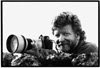
I'm a Pulitzer nominated photojournalist with over thirty years of experience. Mastery of the craft has led me to own and operate my own digital imaging business. As a freelance photo-journalist I have covered a wide variety of photo assignments ranging from local news and sports to international travel. It has been said that - I can't take an ugly photograph.
Wrestling is one of the oldest sports in the world and certainly an interesting one to take pictures of. I find it gets kind of hectic when you're shooting at a tournament when there are two or more mats set up with action going on all at the same time. I normally try to use at least two camera bodies, one equipped with a 24-70mm, another with a 70-200mm, and if possible a third body equipped with a 300mm f2.8, that way I have all my focal lengths covered. When shooting, I try to get story telling shots of most of the matches, the winning, loosing, happiness, you know the thrill of victory, the agony of defeat. Guess it's all those years of shooting sports for newspaper and magazines that has taught me that capturing the reaction after the action is just as important.
I try to get vertical shots of takedowns and escapes and then zoom closer, filling the frame to get pinning combos and closer action. Sometimes the ref in the photo will also tell an important moment in the action.
Be careful, when you're near the mat you start to develop a six sense to know when to drop the camera from your eye and either duck or move. I once had two heavy weights land on top of me. I hurt the better part of a week.
Here's some images that might give you an idea. I shot these inside a gym with decent lighting at 320 sec. at 2.8 with an ISO 1000. Normally, when they set up a single over head flood light for the championship rounds, I set up two or three Canon 550 EX speed lights and use a Speed lite transmitter ST-E2 to fire them.
Taking pictures of celebrities can be a rush job. Most of the time they really don’t care and generally try to accommodate the photographers needs, but it’s their publicists who actually control their clients time and this can be frustrating.
It actually took me longer to find a parking space near the W Hotel in downtown Seattle than it did to set up four of my 550 EX Speedlites, and take a couple of tests shots than it took for me to get some pictures of Carson Kressley, the flamboyant star of TV's "Queer Eye for the Straight Guy", in the lobby. Kressley, who was in town promoting his fashion book of tips for the straight men, "Off the Cuff”, was really great to work with, but his publicists was not.
I’m not trying to say that this individual was hard to work with, but, having him constantly look over my shoulder, wanting to view each captured image was gate keeping at it best and cutting into my allotted shooting time. Finally, after seeing my frustration, Carson suggested to his publicists, the shooting session would pass quicker if he’d look at the images after they were all taken instead of one at a time.
Kressley was great to work with, having model underwear for many years, he was natural in front of the camera and didn’t require any guidance in posing at all and I able to squeeze about 30 pictures off in the 30 minutes photo session before the publicists called it a wrap.
During a photo assignment to take pictures of baby lemurs at the Woodland Park Zoo in Seattle, I ran across a problem in showing just how tiny these furry creatures were when there were stuck behind a glass window and were asleep in their bassinettes. Lucky, a local TV photographer and reporter arrived in the nick of time to solve that problem.
According to the National Press Photographers Associations Code of Ethics rule number 5. It states, “While photographing subjects do not intentionally contribute to, alter, or seek to alter or influence events.” Somehow those rules only seem to apply to still photographers and not TV photographers.
After setting up his camera and tripod in front of the glass window and taking a few shots. He said the one of the Zoo’s staff if they could move the babies closer to the window for a better shot. The staffer walked over to a box of rubber gloves, pick up a green pair and pink pair and asked the TV photographer, which would look better. “Pink”, he replied. I didn’t say a thing and let him set up the photo.
Donning the pink gloves, the attendants picked up the lemurs and moved them closer to the window. Not only by holding them in their hands, give size in relationship to a human hand, but also the pink gloves were a nice added touch of color.
When I returned to the paper and told the story to our Director of Photography, he asked if I said anything at all to change the situation? “Nope, nada, nothing, the TV photographer and reporter set it up", I replied, they took control over the whole situation. “Good, and you managed to get a nice feature picture of a hard subject.” He said.
So next time you see something shot by a TV photographer for the nightly news, you just gotta wonder just how much part they played in contributing to influence the event filmed.
One method I like to use when out shooting sports, news or any other assignment is to put a little blur motion in my photos. This is one way to convey motion to the viewer.
I like to shoot at low shutter speeds (1/60th or slower) using a shorter lens and “pan” or move the camera while shooting. When panning, I keep the camera on the subject and swing with the action until it is directly in front of you. Then press the shutter button as you continue panning and the result you’ll achieve is a blurred background with a sharp subject focus.
You can shoot blur-of-action photos three ways:
1)– Remain stationary and shoot the subject as it passes.
2) – Move along with the subject and shoot in motion.
3)– Remain stationary and pan your camera as the subject moves parallel to you.
Many of you have asked to share my secrets in capturing peak sports action photos you see in newspaper and magazines. One thing, I try to stop the action using a shutter speed of no less that 1/500 second and preferable 1/100 second or higher.
Getting the shot at the peak action requires split second timing, practice and keeping your finger pressed on the shutter button. The best stop action shots have sharp focus and the ball in the frame.
Another success in shooting sports requires a photographer to use long telephoto lenses in the ranges of 200mm, 300mm, 400mm, 500mm and longer. These lenses allow a photographer to use low f-stops at either 2.8 or f 4.0. This not only allows me to blur out the backgrounds, but I’m able to use higher shutter speeds to capture the ball in mid air. Another important reason is that the viewers’ eyes automatically goes to the subject and not wonder around the photo. Always crop your photographs to add impact and eye stopping power to them.
Another helpful hint is you also need to process knowledge of the sport you are shooting so you can anticipate the action.
Here's a few that might show you want I'm writing about.
I enjoy using visual communications in my photography. I like to think It’s not what you photograph, but how you photograph the subject. Some photographs have that talented eye to notice and add that little bit of extra graphic ingredients to a photograph that makes your eye look longer. This type of visual smack is what makes some photography stand out from the ordinary.
Crop for impact: If you want add graphic power, you must crop in on those story-telling elements. Study everything in your viewfinder, the entire frame, not just the center. You can get rid all the distracting elements in the sides, corners or background by changing camera angle, shooting distance, or zoom settings. I try add a better graphic impact by moving in and singling out specific features using a zoom lens or a macro lens to photograph small details.
When taking long or medium shots, I’m always on the lookout for pictures within the picture. Seeing interesting details inside the overall frame, I sometimes make separate pictures of them. By closing in on the light striking a maidenhair fern, I was able to bring out the graphic patterns on the fronds.
Look for reflections: Reflections can help you create striking compositions. They can be found them anywhere: car door windows, even, in water puddles after a rainstorm and in the calm surface of a lake as such as the boater’s reflection in the marina as he washes off his sailboat.
Silhouettes: Look for eye-catching graphic shapes that can be silhouetted against a bright background, such as a sunrise or sunset. For a good silhouette effect, shoot against the light and expose for the bright area, so that the foreground goes dark such as I did of the Salmon fishermen at dusk and able to capture the light reflecting off the fishing lines.
Use of lines: Use lines to make your compositions more graphic to express the mood you want as they curve and lead your eye right into the subject. But using a micro lens to capture the dewdrops as they transform the graceful curves of a spider web into a deadly looking diamond necklace.
Subject placement: Where you position your subject or center of interest within the camera’s viewfinder can also add to graphic impact. According to years of advice that you should never center the subject in the middle of the picture, that’s just plain crazy. It does sometimes create a static composition, but also can produce a powerful bull’s eye effect that pulls the viewer’s eye right into the center ring such as this portrait of an Azorean girl before she went to her first Communication.
Using shapes, patterns and colors: Colors also produce a life of their own. I like to use contrasting bold colors to work with one another, as the contrast of the white daisy against the color of the purple lavender.
The repeated line and patterns of repeated lines, shapes, tones and colors within a scene adds that extra bit of graphic power to your photographs. Sometimes those visual lines may be orderly as the outlines of hills at Hurricane Ridge that create a step ladder leading up to Mount Olympus.
While working for newspapers, photographers shoot a variety of assignments ranging from spot news, general news, sports, feature and documentary. But, there’s nothing more dreaded than being assigned a why I love where I live, my favorite chef, a fine romance, check passing, ground breaking and of course, the school assignment. To the news photographer these are commonly know as “non-photographic events”, but they have to be covered and it’s up to us to capture a story-telling photo.
Most are pretty boring event to cover, so if only teachers would plan ahead and contact the newspaper’s education beat reporter and inform them of an ongoing class project. That would actually make better pictures than kids standing next or pointing to a finished science project. The same goes for ground breakings, instead of having to capture pictures of local officials moving dirt with a shovel, how about stopping by ever so often at the construction site to make pictures of workers. I tried to train our reporters on what makes a visual assignment or not. From time to time I had to tell them, that this is one assignment where 5,000 words is a lot better than one crappy photo.
Once I received an assignment to cover Presidential Candidates at The Islander Middle School . Eight graders were taking part of a social studies class using Story path, an educational program in which they create an election campaign, with candidates, platforms and posters. Sounds pretty boring and why yes it was. I could have gotten a few shots of the candidates standing at a podium giving a speech, but for some reason I decided something there might make a good photo. Besides, if I returned to office after this assignment, there might be a worse one waiting. I have this thought, if you’re out of the office your working, you know out of sight, out of mind to the editors and another photographer would get handed a “last minute” assignment.
I’ve been following this one group from classroom to classroom when the candidate, dressed as Herbert Bobman, for the Peace Party, had her nose tweaked by a classmate. So, instead of handing in a speaking at a podium pictures, I stayed longer and the paper published a nice story telling feature.
Jim Bryant is a Pulitzer nominated photojournalist with over thirty years of experience. His mastery of the craft has led him to own and operate his own digital imaging business. freelance photo-journalist who has covered a wide variety of photo assignments ranging from local news and sports to international travel and war. He picked up his first camera at the age of 15 and has been taking pictures ever since. From the Central American rainforest to the ice sculptures in Japan's most northern island to the plains of Africa, it has been said that- Jim Bryant can't take an ugly photograph.