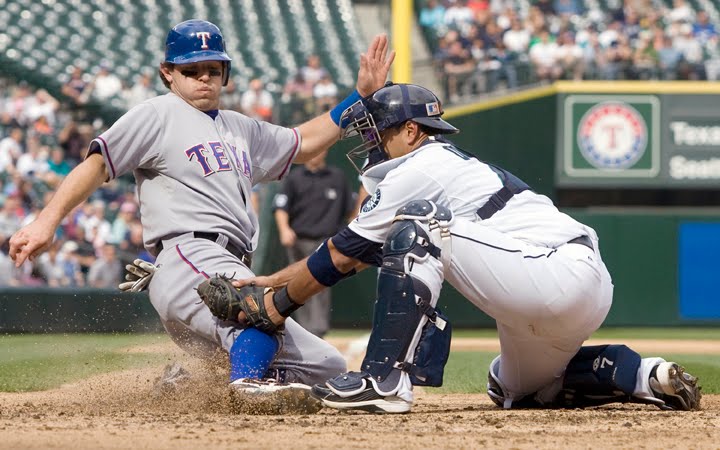
It's all about getting in the right shooting position in order to capture good action. Normally, when I cover a baseball game I start out in either the inside or outside home photos wells to shoot the starting pitchers. But during the last Rangers vs. mariners game I trusted my gut feeling and opted to hang out in the first base line photo well to get pictures of the infielders and outfielders in action and significant plays at first and second bases as well as outfield action. After capturing a few pictures at that location, I moved to the inside home photo well on the other side of the Mariners dugout where I captured another play at home plate as well as the safe at second. A few innings there, I moved over to the outside home photo well to make a pictures of Texas Ranger's pitcher Tommy Hunter pitching, safe at third, a different view of a play at home, Tommy Hunter wiping the sweat from his forehead before being relieved in the seventh inning and lastly, the Mariners closer David Aardsma hugging catcher Guillermo Quiroz after preserving a 2-1 win over the Rangers. Sometimes it's just 95% being in the right location and 5% dumb luck.
Wednesday, September 22, 2010
Friday, September 17, 2010
This Lady takes the Cake
I thought I had seen it all while covering the Seattle Seahawks games, but this lady takes the cake in the originality category. I spotted her decked out in her "Hawkhooters" before kickoff at the San Francisco 49er vs. Seahawks game on Opening Day. Some Seahawks fans come dressed as the Hulk, umpires, Scottish Highlanders and in all manner of blue and green costumes complimented with face paint and spiked hair. And, I’d have to go as far to say they pretty much rival the Oakland Raiders fans of Raider Nation in the weirdness and craziness categories. This proves a point that not all action is on the field.
Wednesday, September 8, 2010
Juniors Final Hit
Here's a picture I captured of Ken Griffey, Jr., being congratulated after hitting a game winning walk-off single against the Toronto Bluejays. Bluejays' first baseman Lyle Overbay (R) walks off the field as Seattle Mariners mob Griffey in the ninth inning at SAFECO Field in Seattle May 20, 2010. Griffey, pinch-hitting for Josh Wilson, hit the game winning single to right field that scored Milton Bradley in beating the Bluejays 4-3. I was able to capture the opposite emotions in one frame, the happiness of the celebrating Mariners players and the dejection displayed by Overbay as he walked off the field with his head down.
Come to find out this was his final hit at Safeco Field. On June 3rd he retired from Major League Baseball.
This picture is a fitting tribute that brought an end to a historic record of his final achievements in a hall of fame career.
Come to find out this was his final hit at Safeco Field. On June 3rd he retired from Major League Baseball.
This picture is a fitting tribute that brought an end to a historic record of his final achievements in a hall of fame career.
Wednesday, September 1, 2010
Coming home to roost
Ever since we moved into our present home 15 years ago, we have raised generation after generation of squirrels, crows, peeps and Blue Jays, which made nests in the trees surrounding our home. A few years ago Amy had me cut down a big Cedar tree, which was home to our Blue Jays. Now, every morning I am woken to the racket this hungry little fellow makes in a tree right outside our bedroom window. So, I grabbed my 70-200mm and went searching among the limbs of the Douglas fir. Here he is all puffed up and trying to look big and dangerous. As I got nearer and nearer to the nest, the bigger he tried to make himself. Even through they make such a racket in the mornings, it's fun watching the babies grow up, make their first flights, peck around the yard and have babies of their own one day.
Wednesday, August 25, 2010
Using Clouds to your advantage
What a difference in what 24 hours make. While walking my dog on Monday, I spotted a really neat scene of The Brothers in the Olympic Mountain range shrouded by a low-lying cloud layer. After the walk, I loaded by gear into the car and headed to a high vantage point where I could get a much clearer picture of the mountains. The low cloud layer is what really makes this photograph stand from the one I took 24 hours later. I used my 400mm f2.8 with a 1.4 converter to get a tighter shot of the mountains. Keep on the lookout for clouds and when ever possible add them into your landscapes to dramatize and enhance the terrain.
For all who’s interested in what setting I used, here they are:
Date: 8/23/10
Time: 9:00:54
Latitude:
Longitude:
Model: Canon EOS-1Ds Mark II
Serial #:
Firmware: Adobe Photoshop CS4 Macintosh
Frame #:
Lens (mm): 560
ISO: 160
Aperture: 32
Shutter: 1/60
Exp. Comp.: -1.3
Flash Comp.:
Program: Aperture Priority
Focus Mode:
White Bal.:
ICC Profile: Adobe RGB (1998)
Wednesday, August 18, 2010
Using Fill Lighting to enhance the Photo
Recently I was commissioned to take a series of informal portraits of Larry Stokes, one of Kitsap County’s Port Commissioners. The Marketing/Communications Manager warned me beforehand that he can be a bit of a difficult, but once he warms up to you, he has a heart of gold.
When getting out of the car, I was greeted by his two dogs, which treated me like a long lost friend. Round one to my side. After unloading my car and while setting up lights, on the porch, he asked since it was sunny outside why did I need portable flashes. I went into explain that it’s good to use a tad bit of fill flash to fill in the shadows, especially when you were metering for the ambient light.
After finding an ideal location on his porch, I fired off a couple of tests and showed him the results and explained why I needed to set up a few of the flashes and adjust the output for less light. While taking pictures the dogs came up to join him, which only added to his personality.
After the shoot he invited me into his den, which looked as if it was taken from a scene of an old Alfred Hitchcock move, “Psycho”. Hanging on the walls were stuffed heads, all shapes and sizes, ranging from moose, varies varieties of deer, analopes, mountain sheep to a huge Alaskan bearskin. Also posed in the room corners were a stuff cougar, raccoon and a couple of bears fighting in a corner. He said once while hunting in Alaska he came upon the two bears, one black and other fighting, and killed them. He’s also a hunting guide and a very talented taxidermist.
Posing him in the den, with a bunch of stuffed animal heads on the wall made the photograph work. Using the tools of his trade, elements in the background all added to this environmental portrait.
I wanted to get Larry in a shaded setting and away from the 3:00 sunlight. I used a two 550EX light setup for the porch pictures (both headshot and overall). One light was set about three feet from the subject on camera left, while the other was camera right about five to six feet from the subject.
I really liked the way the porch was in the shade and wanted to utilize the leading lines of the railing, decking and house as they lead right into the subject. Plus, the sunlight spilling onto the decking through the railing also added a nice touch as well. I metered for the overall ambient lighting which was 125th for ISO 50 and I set the flashes output at -1 2/3 (camera right) and - 1 1/3 (camera right). I took a few test shots to make sure the flashes didn't overpower the existing light and make adjustment to f-stop and set the Ev to Exp. Comp.: -0.3. I always strive to balance the flash output to the existing lighting so that the lighting looks natural.
Flash fighting placement for or the inside shots were: one camera left, beside the subject, pointed at the wall to shed light on all those heads in the background. Another was camera left pointed at subject and the 3rd light was camera right. I always meter for the existing light in the whatever location I’m in and then set ISO, flash output, shutter speed and f-stop to get the correct mixture lighting, so that I don't get harsh shadows.
I used my 16-35mm f2.8 lens for the porch and inside shots and used my 70-200mm for the outside headshot.
Hope this helps everyone to understand what going on through my head as I try to figure out the correct balance between the existing light and my flash output.
When getting out of the car, I was greeted by his two dogs, which treated me like a long lost friend. Round one to my side. After unloading my car and while setting up lights, on the porch, he asked since it was sunny outside why did I need portable flashes. I went into explain that it’s good to use a tad bit of fill flash to fill in the shadows, especially when you were metering for the ambient light.
After finding an ideal location on his porch, I fired off a couple of tests and showed him the results and explained why I needed to set up a few of the flashes and adjust the output for less light. While taking pictures the dogs came up to join him, which only added to his personality.
After the shoot he invited me into his den, which looked as if it was taken from a scene of an old Alfred Hitchcock move, “Psycho”. Hanging on the walls were stuffed heads, all shapes and sizes, ranging from moose, varies varieties of deer, analopes, mountain sheep to a huge Alaskan bearskin. Also posed in the room corners were a stuff cougar, raccoon and a couple of bears fighting in a corner. He said once while hunting in Alaska he came upon the two bears, one black and other fighting, and killed them. He’s also a hunting guide and a very talented taxidermist.
Posing him in the den, with a bunch of stuffed animal heads on the wall made the photograph work. Using the tools of his trade, elements in the background all added to this environmental portrait.
I wanted to get Larry in a shaded setting and away from the 3:00 sunlight. I used a two 550EX light setup for the porch pictures (both headshot and overall). One light was set about three feet from the subject on camera left, while the other was camera right about five to six feet from the subject.
I really liked the way the porch was in the shade and wanted to utilize the leading lines of the railing, decking and house as they lead right into the subject. Plus, the sunlight spilling onto the decking through the railing also added a nice touch as well. I metered for the overall ambient lighting which was 125th for ISO 50 and I set the flashes output at -1 2/3 (camera right) and - 1 1/3 (camera right). I took a few test shots to make sure the flashes didn't overpower the existing light and make adjustment to f-stop and set the Ev to Exp. Comp.: -0.3. I always strive to balance the flash output to the existing lighting so that the lighting looks natural.
Flash fighting placement for or the inside shots were: one camera left, beside the subject, pointed at the wall to shed light on all those heads in the background. Another was camera left pointed at subject and the 3rd light was camera right. I always meter for the existing light in the whatever location I’m in and then set ISO, flash output, shutter speed and f-stop to get the correct mixture lighting, so that I don't get harsh shadows.
I used my 16-35mm f2.8 lens for the porch and inside shots and used my 70-200mm for the outside headshot.
Hope this helps everyone to understand what going on through my head as I try to figure out the correct balance between the existing light and my flash output.
Wednesday, August 11, 2010
Educate Your Clients and Other Photographers
A prospective customer recently emailed me saying my print prices are too high.
“Your prices are outrageously high. Photos are good but not $5.00 a piece good, maybe $2.00.
I will check with the other parents who had cameras and get copies from Costco for .14 each.
After what we paid to send them there and then to pay these prices for photos, I may consider one photo, but can’t pay these prices”.
My response: I understand the way you feel, sending kids off to sporting events aren’t cheap. I have a son who wrestles and goes all over Washington to participate in Tournaments and a daughter who used to own a horse and go Western Gaming.
I also added, that last year I lowered my prices so that clients could afford them. I hope you understand that I can’t give my photography away for $2.00 a print. Being a 40-year plus veteran photographer and without the benefit of another full-time job to rely on, this is now my full-time job that brings in money to support my family of four.
When you look at my vast experience, with the costs involved with the purchase and upkeep of professional digital camera equipment and lenses, not to mention the computer, software programs to post process the images and then add the costs of DVD’s and external hard drives to store the images on, this is expensive. But wait, there’s the monthly fees associated with posting the images on Photoshelter, and Exposure manager. Then on top to those, add health insurance, studio rent, insurance, office supplies, phone service, utilities and the list goes on and one. I have to make a certain amount a day to meet my Costs of Doing Business, otherwise, I'll be out of business.
Because of my experience, I'm provide field access closer to the action while most parents are limited to shooting from the stands. I know where to stand on the field and when to press the shutter button to provide my clients the best sports action photography available.
All I can say is go online and check out the other photographers prices. Some are about the same if not higher than mine. $5.00 for a 4 x 6 is pretty damn cheap for the quality you're getting.
I understand that with the advancements in dSLR technology and digital age has made picture taking so easy that about every housewife, father, cave person and perhaps even a gorilla can shoot a picture. I've known some have who had thoughts of turning pro after a few short months behind the viewfinder. Unfortunately, these folks, who already have full-time jobs, look upon photography as a way to make a few extra bucks and don't know the actual costs of doing business in photography. Like most under educated photographers they either charge 25 cents a photo or they give them away to friends for free.
You can however purchase one of my 4 x 6 digital downloads for $5.00 each and take them to Costco to get your unlimited low resolution at.14 cents a prints printed.
This is a point in case that is happening to every professional photographer out there. It's up to us to educate our clients and other photographers on the true cost of doing business in photography.
Subscribe to:
Posts (Atom)